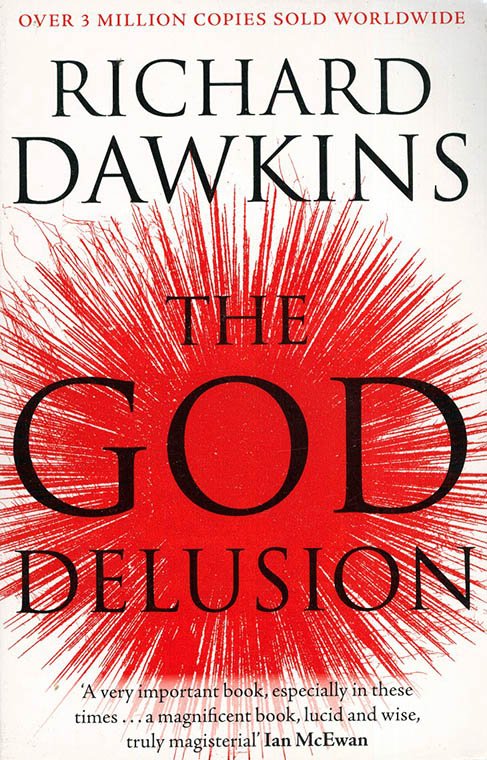


The God Delusion
රු2,000.00 Original price was: රු2,000.00.රු1,050.00Current price is: රු1,050.00.
ISBN : 978-0-552-77331-7
Author: Richard Dawkins
Publisher: Black Swan Books
1 in stock
Why bother, as an ecologist, to read and think about
God and religion? Because science and logical reasoning
have always been bedevilled by religious leaders, even
(or particularly?) by revolutionary zealots such as
Martin Luther (quoted from Dawkins book, p. 221):
‘‘Reason should be destroyed in all Christians’’. The
more interesting question is: Is Dawkins’ book helpful in
this debate?
Chapter 1 sets the stage using Einstein’s metaphorical
use of the word ‘‘God’’ for an orderly principle of
nature’s working, as opposed to a personal, interfering,
prayer-answering god. In Chapter 2 Dawkins formulates the ‘‘God Hypothesis’’, basically: ‘‘There is no
god’’, and the alternative: ‘‘Evolution can explain all
patterns in living nature’’. It follows a brief outline of
religious believes, from (ancient to catholic) polytheism,
through monotheisms onto the Spaghetti-Monster.
Chapter 3 reviews arguments in favour of God’s
existence, which he dismisses, one by one, as illogical,
circular reasoning or – mostly – irrelevant: Most are
based on the desire that there must be a sense in life –
which adds nothing to the question of God’s existence.
Chapter 4 collects arguments against God’s existence,
thus probably the pivotal chapter in the book. As that, it
is also its weakest. Firstly, Dawkins correctly states
(a) that it is impossible to disprove God’s existence, and
(b) that onto believers falls the burden of prove for their
‘‘grotesque’’ claim, not on atheists the disprove. He then
offers two lines of argument to show that God’s
existence is unlikely. (I) If God made the universe,
who made God? This argument basically says that
assuming God as existing is not a ‘‘simple’’ explanation,
as his provenance must be explained by invoking a more
complex ‘‘super-creator’’, which in turn requires a
‘‘super-super-creator’’ and so forth, into infinite regress.
(II) Everything that needs to be explained can be, in
principle, explained by natural selection and the
anthropic principle. Thus, God is not necessary and
not the most parsimonious explanation for natural
phenomena. Dawkins also uses the chapter to do what
he does best, to defy creationist attacks against science.
Chapter 5 seeks to understand how religions came
into being, for example as by-product of the evolutionary useful faith of young children in their parents.
Chapters 6 and 7 show first that ‘‘religious moral’’ is not
really derived from scripture (but rather that bible,
koran and alike are written to express a set of moral
values already existent); that religions and their representatives pick and choose from the diversity of rules
scripture offers; and finally that moral – religious or not
– changes through time. In Chapters 8 and 9 Dawkins
justifies his hostility towards religions by giving examples of hate, intolerance, discrimination and mental
abuse by religious leaders around the world and
particularly in present-day United States. He closes, in
Chapter 10, with an encouragement to break free from
religious restrictions and enjoy the ‘‘wonders’’ of the
world untarnished by superstition and absurdity-ridden
religious ballast.
Overall, the book makes good reading to any (near)
atheist. Since many pro-God arguments are contrasted
with evolutionary theory, this book requires a proper
understanding of evolution through natural selection,
for which his ‘‘The Blind Watchmaker’’ is a more
thorough treatment. Will this book change the world to
the better? That is very unlikely: Dawkins generally
argues on logical reasoning, as did the also famous
Bertrand Russell 80 years ago. Why did he, then, not
succeed in making the world atheistic? Because, as
believers argue, logical reasoning is not the way to
investigate faith. So really, the world seems to be divided
into those who accept logic as a method to assess the
truth in everything, and those who limit logic’s realm to
the material world (whatever that may be in an age of
quantum mechanics). For the former, the book will be
either entertaining or controversial, for the latter it is
simply inaccessible.
| Weight | 0.32 kg |
|---|---|
| Dimensions | 20 × 12.8 × 2.8 cm |